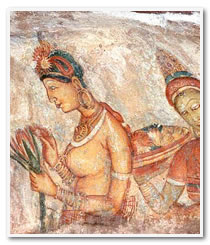
During the last one million years, when humans are known to have existed in various parts of India, Sri Lanka was connected to the sub-continent on numerous occasions. The rise and fall of sea level (due to cold/warm fluctuations in the global climate) determined the periodicities of these connections, the last separation having occurred at ca. 7000 BP. There is secure evidence of settlements in Sri Lanka by 130,000 years ago, probably by 300,000 BP and possibly by 500,000 BP or earlier.
The Lost Continent of Lemuria (The lost continent of Lemuria (Mu) was originally referenced in the works of several 19th century scientists. Observing similarities between the geology and fauna of India and Madagascar, some scientists theorized that there once existed a huge land mass (Lemuria) in the Indian Ocean that spanned the two locales. As with Atlantis, the days of Lemuria came to an end with a cataclysmic natural disaster that sank the continent into the sea.)
Prehistoric basis for the rise of civilisation in Sri Lanka and southern India (Batadomba-lena cave, Sri Lanka (29,000-9,500 B.C.), where the ramains of prehistoric humans have been found)
ARCHAEOLOGICAL EVIDENCE OF TECTONIC ACTIVITY (AND TSUNAMIS) IN SRI LANKA(The gravels with artifacts are today at considerable heights above the present sea level: 15 metres at Bundala-Patirajawela dated to 125,000 years ago and 8 metres at Bundala-Wellegangoda dated to 80,000 years before the present. Occurrences of ancient coastal gravels inland around Mankulam and on Aruakallu at 60-80 metres and at Minihagalkanda in Yala at 40 metres have yet to be scientifically dated. At least some of the ancient coastal gravels mentioned above suspiciously resemble residues from past tsunamis)
Pre- and protohistoric settlement in Sri Lanka (By S. U. Deraniyagala, Director-General of Archaeology, Sri Lanka)
Early Man and the Rise of Civilisation in Sri Lanka: the Archaeological Evidence (By S. U. Deraniyagala, Director-General of Archaeology, Sri Lanka: It is therefore possible that humans were present in Sri Lanka from at least as early as one million years ago. There are ancient coastal sands in the north and southeast of the island which could be as old as 250,000 BP or even 700,000-500,000 BP. These deposits may contain evidence of human habitation, a prime research objective for the future. )
Prehistoric and early historic burial sites of Lanka (Sri Lanka's North-Central and North-Western Regions are dotted with numerous burial sites that are believed to be well over 2000 years old'. These prehistoric and early historic sites have revealed two distinct burial customs, namely urn burials (where the dead were placed in huge urns and interred) and cist burials (where the ashes of the deceased were interred in large tombs hidden under the ground)
A Book: The Prehistory of Sri Lanka: an Ecological Perspective (By S. U. Deraniyagala,Director-General of Archaeology, Sri Lanka: memoir volume 8 of the Archaeological Survey of Sri Lanka, is the first comprehensive, in-depth account to have been written on the subject. It is the definitive text on the prehistoric archaeology of the island. )
Pallemalala discovery throws new light on Lanka's pre-historic culture (A major archaeological breakthrough that could shed new light on the physical type and lifestyle of the island's pre-historic population has been accomplished by a team of Sri Lankan Archaeologists )
Pallemalala: Several thousand years ago Here they lived and died ( Several thousand years ago, a group of pre- historic people set up camp at a dried-up lagoon bed in Hambantota. Here, they lived, hunted and fished for food and upon death they were buried under the very same ground. )
NASA Images 1,750,000 Year Old Man-Made Bridge between India and Sri Lanka ( Space images taken by NASA reveal a mysterious ancient bridge in the Palk Strait between India and Sri Lanka. The recently discovered bridge currently named as Adam4s Bridge is made of chain of shoals, c.18 mi (30 km) long. The bridge4s unique curvature and composition by age reveals that it is man made. The legends as well as Archeological studies reveal that the first signs of human inhabitants in Sri Lanka date back to the a primitive age, about 1,750,000 years ago and the bridge4s age is also almost equivalent.)
The ports of ancient Sri Lanka: Jambukola and Mahatittha ( Jambukola and Mahatittha are two ports frequently alluded to in the Mahavamsa unfolding the earliest historical eras of the Island. Presumably the origin of these ports are not datable, however, it could be assumed without any predilection, that they were in existence long before the colonization of the Island by Aryans in the sixth century BC. )
Godavaya: glorious harbour in the maritime Silk Route 2nd century AD ( It seems almost like a modern harbour - but all this happened as far back as the 2nd century AD in Godapavata Pattana, west of Hambantota. Evidence is being unearthed every day to prove Godavaya's importance in the maritime Silk Route, with excavations and research revealing connections from China in the East to the Red Sea and the Mediterranean in the West. )
Guharamaya: a cave of stone age man ( About four miles to the north of Rambukkana, in the heart of a village on the plain beside a plantation of jak, is a curious structure of stone, like the table of some giant of the good old days. It is called by local folk, Maliyadeva Guharamaya, the dwelling of the last great Initiate of Buddhism in our island. The dolmen at Padavigampola is the only known example in Ceylon of structural work by Stone Age man. )
India - Sri Lanka: Search for a common past (The gempits in the Ratnanapura area have also revealed the fossilised remains of the lower jaws and teeth of a Ceylon hippopotamus and rhinoceros. The lower jawbone of the hippopotamus reveals six incisor teeth, whereas the hippopotamus that survives in Africa has only four incisors. The extinct Ceylon hippopotamus has been named the Hexaprotodon sinhaleyus Deraniyagala 1937. The change in climate _ from heavy rainfall that fed numerous large rivers and lakes to a more moderate rainfall that reduced the island's waterbodies _ was probably responsible for the extinction of the world's second heaviest land mammal in the island, thought Deraniyagala Senior)
Sri Lanka's History : In Danger of Disappearing (Environmentalists warn that unchecked vandalism and neglect is destroying thousands of ancient rock caves in Sri Lanka dating back to 30,500 BC, with scores of Buddha statues rendered headless, and paintings defaced. One of the most priceless relics here is a female body remains in Bulathsinhala, in Kalutara district in the Western province, which testifies to the consumption of rice, maize and salt. This body remains embedded in a rock dates back to 30,500 BC and is considered the world's oldest proof of consumption of rice, maize and salt.)
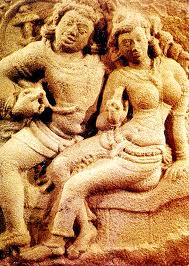
SIGIRIYA.
Nothing in Sri Lanka captures the imagination more than a 200 meter lump of granite that rises starkly above the flat central plains. Sigiriya has it all -- a blood-stained history full of intrigue, astonishing frescos of bare-breasted maidens painted 15 centuries ago, a wall covered in graffiti that is more than 1,000 years old and, to top it all, Asia's oldest surviving landscape garden.

